B2 First: Formal Letter (Letter to the Editor)
TOPIC
The 4 Categories of Mistakes
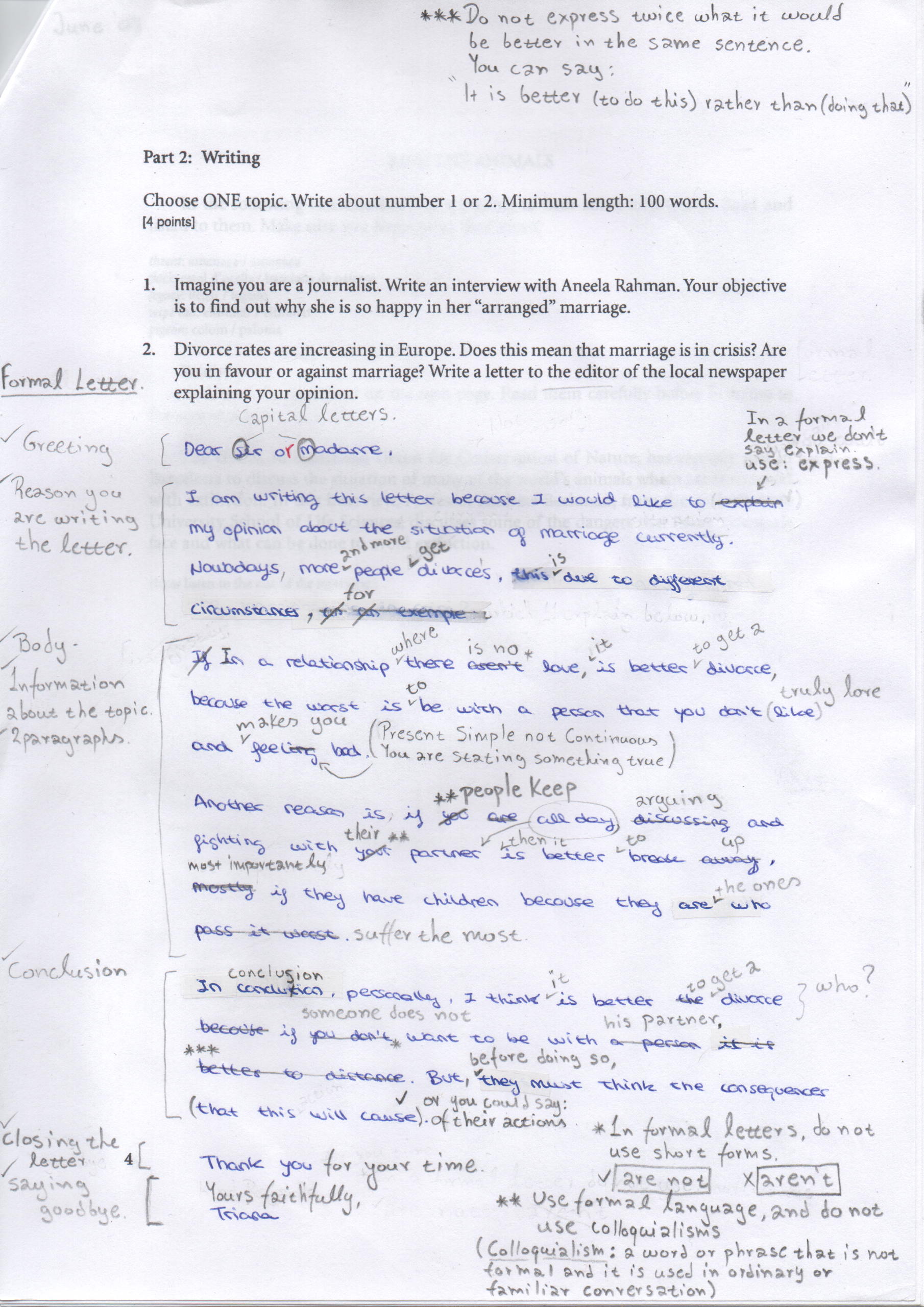
Analyzing student writing requires looking past individual red marks to find the underlying patterns. Triana’s draft highlights four distinct error categories common among intermediate learners.
Register & Style (Formal Letter Requirements)
A letter to an editor demands a consistently formal tone. The student slipped into conversational English in several places:
- Contractions: Used short forms like aren’t and don’t. Formal writing requires full forms (are not, do not).
- Incorrect Collocation: Wrote explain my opinion. In formal English, you express an opinion; you explain a concept.
- Conversational Fillers: Included for example : and and feeling bad. These sound too casual for an official letter.
First-Language (L1) Interference & Literal Translations
Many ESL learners passively translate phrases directly from their native language. In this draft, we see strong evidence of literal translation from Spanish:
- The “False Friend” (Discutir): Used discussing to describe a conflict. In English, a discussion is peaceful. The teacher corrected this to arguing or fighting.
- Literal Idioms (Pasarlo mal/peor): Wrote pass it worst. This direct translation sounds completely unnatural in English. The teacher replaced it with suffer the most.
- Literal Verb Usage (Distanciarse): Used to distance as a standalone action to mean separating from a partner, which does not work in this context.
Grammar & Syntax (Sentence Structure)
A passing B2 paper requires good control over simple grammatical structures. The main issues here involve sentence patterns and missing words:
- Missing Dummy Subject (“It”): Wrote is better divorce and is better break away. English sentences require the placeholder subject it (it is better to…).
- Missing Auxiliary Verbs: Omitted the verb “to be” in the phrase this due to, which must be this is due to.
- Incorrect Word Order: Wrote if you are all day discussing. The teacher restructured this into a much more natural English pattern: people keep arguing.
- Pronoun Disagreement: Switched to your partner while discussing a plural third-person subject (people). This was corrected to their partner.
Mechanics & Accuracy
These are errors regarding basic spelling, mechanics, and preposition rules:
- Capitalization: The salutation was written in lowercase (Dear sir or madame). Formal greetings require Capital Letters (Dear Sir or Madam).
- Spelling: The time marker Nowdays was corrected to the accurate spelling: Nowadays.
- Dependent Prepositions: Wrote think the consequences. In English, the verb think requires a preposition here, making it think of or think about the consequences.
Corrected Version
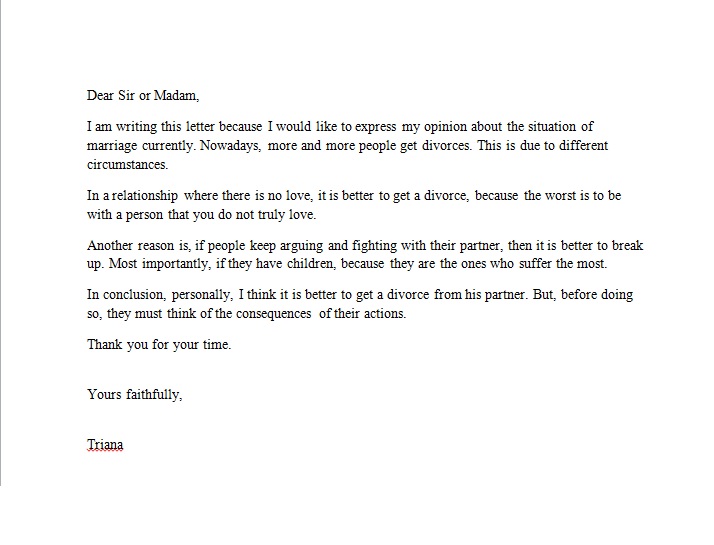
This version corrects all of the student’s grammatical errors, removes informal contractions, and fixes the literal translations from Spanish. It uses natural, realistic B2-level vocabulary and transitions while keeping Triana’s original structure.
Cambridge B2 First (FCE) Official Assessment
If Triana submitted her original draft (before the teacher’s corrections) for the official Cambridge B2 First Exam, she would not pass. While her text has a clear paragraph layout, the density of language errors drops her overall score to a B1 level.
- Content: 5 / 5 (Excellent)
The student fully addresses the prompt. She states her opinion clearly, discusses the rising divorce rates, and meets the base prompt requirements. - Communicative Achievement: 2 / 5 (Below Target)
The letter fails to maintain a consistently formal register. The inclusion of contractions (don’t, aren’t) and casual conversational phrasing violates formal letter protocols. - Organisation: 3 / 5 (On Target)
The layout is logical, featuring a clear introduction, body paragraphs, and a formal closing. However, the linking words are very basic (because, another reason is) and lack B2 variety. - Language: 1.5 / 5 (Weak)
Frequent errors in basic grammatical structures pull this score down. The combination of missing subjects (is better), missing auxiliary verbs (this due to), and heavy literal translations (all day discussing, pass it worst) prevents a passing B2 score.
Estimated Scale Score: 140–150 (Grade C at a B1 Level)
The Model Answer: Passing B2 Grade Letter
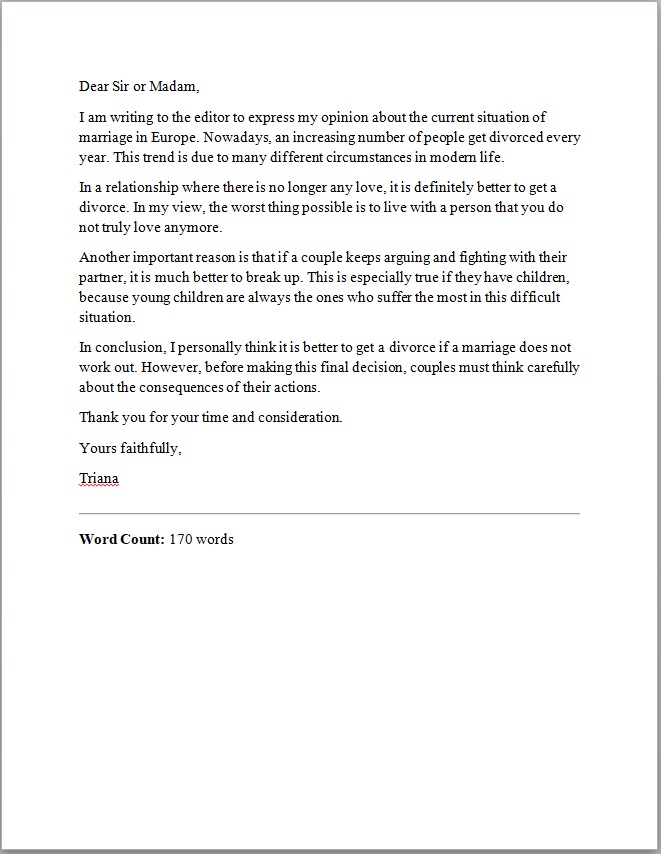
To pass the exam, the text must eliminate all grammatical errors, maintain a strict formal register, and meet the official Cambridge FCE word count requirement of 140 to 190 words.
The model below resolves every error while using realistic B2-level grammar and vocabulary that an intermediate student can naturally produce.
Lesson Plans B2
Lesson Plans B2 Upper-Intermediate The ultimate curriculum: A complete course of premium lesson plans to confidently prepare your students for the Cambridge B2 First examination. Lessons 1 -11 Cambridge B2 First Cycle 1: Foundation Build
The Structure of Articles – B2 First
The Structure of Articles Cambridge B2 First (FCE) The Structure of Articles Purpose of an article The goal of an article is usually to talk about a topic you like or in which you are